
 Global
 Chinese
 United States
 Spain
Spain Russian
 France
 Germany
 Italian
 Japan
Japan Arabic
 Portuguese
 Korean
 Thai
Thai Greek
Greek India
India

High-Purity Raw Material Manufacturing Becomes the Focus of Supply Chain Competition
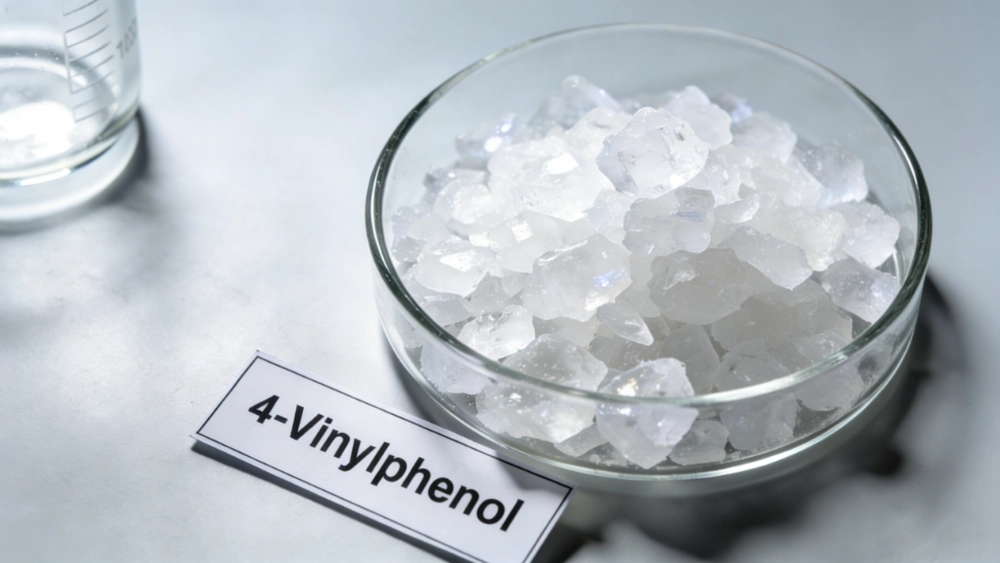
As semiconductor manufacturing, display technologies, and high-performance functional materials rapidly evolve, the purity and structural stability of base monomers are becoming decisive variables affecting terminal performance. Among these, 4-Vinylphenol (4-VP)—a functional vinyl monomer featuring a phenolic hydroxyl structure—plays a pivotal role in Deep Ultraviolet (DUV) photoresist resins, TFT insulation materials, and specialty ion-exchange resins. With the continuous advancement of leading-edge processes and precision materials, the market is demanding more stringent quality control and stable supply capabilities for high-purity 4-VP. In this blog post, Viablife, as high quality critical structural monomer factory, will share the applications of 4-vinylphenol in advanced electronic materials and specialty functional resins.
DUV Lithography Drives Demand for High-Performance Monomers
In advanced integrated circuit manufacturing, DUV lithography sets rigorous standards for the optical transparency, resolution, and etch resistance of photoresist resins. As a vital phenolic functional monomer, 4-Vinylphenol is instrumental in constructing polymer backbone structures that offer excellent transparency and thermal stability.
Compared to traditional phenolic systems, materials incorporating the 4-VP structure exhibit superior resolution control and processing stability, making them a key component in high-end photoresist formulations. As semiconductor nodes continue to shrink, the impact of monomer purity on material performance is magnified, highlighting the increasing importance of upstream raw material manufacturing.
Functional Support in TFT and Display Materials
In Thin-Film Transistor (TFT) display technology, the electrical insulation and interface stability of materials directly correlate with device lifespan and display quality. 4-Vinylphenol serves as a functional monomer in the preparation of high-insulation polymer materials used for dielectric layers or interface modification systems.
The phenolic hydroxyl group in its molecule enhances the polymer’s cross-linking density and adhesion. Against the backdrop of rapid growth in high-resolution and flexible display devices, the significance of such structural monomers is rising. As the global display industry trends toward high-end and ultra-thin applications, the quality and stability of functional monomers have become core supply chain issues.
Expansion into Specialty Ion-Exchange Resins and Environmental Applications
Beyond electronic materials, 4-Vinylphenol is widely utilized in manufacturing ion-exchange resins with specific chemical selectivity. Its phenolic hydroxyl structure allows for the construction of polymer networks with targeted functional group distributions. This enables resins to demonstrate excellent selectivity and durability in heavy metal recovery, precious metal extraction, and the purification of fine chemicals. With tightening environmental regulations and the increasing need for resource recycling, the market for high-performance resin materials continues to expand, further deepening the reliance on high-quality functional monomers.
Manufacturing Capability as a Key Competitive Edge
In advanced material systems, monomer purity and impurity control often directly influence the molecular weight distribution, optical properties, and electrical stability of the resulting polymers. Industry observers note that as downstream applications move toward high-end sectors, raw material manufacturers with large-scale production capabilities and sophisticated quality control systems will occupy a more strategic position in the supply chain.
Aligning with this trend, Viablife has established production for 4-Vinylphenol. Through process optimization and robust quality systems, the company has achieved continuous improvements in product purity and batch consistency. Viablife provides stable monomer support for semiconductor material enterprises, display material manufacturers, and specialty resin producers. Industry experts believe that the ability of upstream suppliers to ensure the stable delivery of critical monomers will be the cornerstone of collaborative development across the advanced materials value chain.
Long-Term Value for the High-End Materials Market
As semiconductor manufacturing processes evolve toward higher precision, display technologies upgrade to flexible and high-resolution formats, and eco-friendly separation and purification technologies gain traction, the strategic importance of 4-Vinylphenol continues to rise. Through its robust manufacturing capabilities and rigorous quality management systems, Viablife is committed to becoming a trusted monomer raw material partner in the fields of electronic materials and high-performance functional resins.
From photoresists to functional resins, the quality of the monomer has become a decisive factor in determining the performance ceiling of the final material. In today’s increasingly competitive high-end manufacturing landscape, the reliability and stability of base raw materials have become vital links in defining supply chain competitiveness. 4-Vinylphenol is more than just a chemical name; it is a critical bridge connecting advanced manufacturing with innovation in functional materials.

 Leave a Message