
 Global
 Chinese
 United States
 Spain
 Russian
 France
 Germany
 Italian
 Japan
 Arabic
 Portuguese
 Korean
 Thai
 Greek
 India


Understanding What Skin Barrier Repair Really Means Through the “Brick-and-Mortar” Model
Browse through your skincare shopping list, and you will find “ceramides” almost everywhere. They appear in barrier-repair creams, restorative serums, and seasonal emergency moisturizers. Today, ceramides have become almost synonymous with skin barrier repair.
However, being familiar with the name does not mean truly understanding these molecules. Why have ceramides become one of the key ingredients associated with skin barrier repair?
In the “brick-and-mortar” structure of the stratum corneum, corneocytes act as the “bricks,” while ceramides, cholesterol, and free fatty acids form the intercellular “mortar.” These three components work together, but each has a distinct role [1]:
Ceramides: Play a leading role in assembling lipid lamellar structures and are core components of the skin barrier.
Cholesterol: Regulates lipid flexibility and helps maintain membrane elasticity.
Free Fatty Acids: Help establish and maintain the mildly acidic environment of the skin surface.
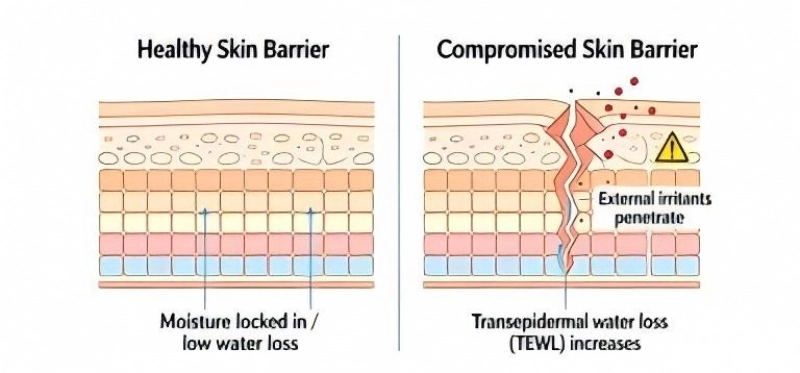
If ceramides, cholesterol, and free fatty acids are all essential components of this “mortar,” why have ceramides become the central focus of skin barrier repair? The answer lies in their proportion within stratum corneum lipids and the differences among ceramide subclasses.
01. Nearly 50%: Why Ceramides Are a Core Component of the Skin Barrier
In the intercellular lipids of the healthy human stratum corneum, ceramides account for approximately 40%–50% of the total, cholesterol accounts for around 25%, free fatty acids account for approximately 15%, and other lipids make up about 10%.
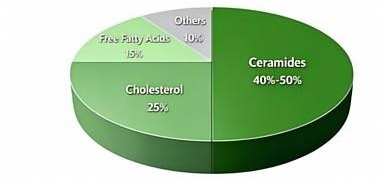
Composition of intercellular lipids in the healthy human stratum corneum [1]:
However, this nearly 50% proportion represents only the total ceramide content. Human skin contains at least 12 ceramide subclasses, including NP, AP, and EOP. [2] Differences in sphingoid bases, fatty acid chain lengths, and hydroxylation patterns determine the distinct roles of individual subclasses.
Ceramide NP: A key barrier-supporting component. It helps strengthen cohesion between corneocytes and reinforce the physical skin barrier.
Ceramide AP: A component involved in moisture regulation. It helps support skin hydration processes and maintain normal stratum corneum turnover and moisture balance.
Ceramide EOP: A structural anchoring component. Its ultra-long-chain ω-hydroxy fatty acid can bind covalently to corneocytes, helping improve the skin’s mechanical stability and structural integrity.
Clinical measurements indicate that skin with impaired barrier function, such as the skin of people with atopic dermatitis, may show not only a reduction in total ceramide content but also decreases in specific subclasses and imbalances in the relative proportions of different subclasses.
This highlights a common misconception in skincare formulation: adding any ceramide to a formula does not necessarily mean that the skin barrier has been effectively repaired.
The molecular structure of the ingredient, including its carbon-chain length and compatibility with the skin’s native lipids, influences whether it can integrate into the intercellular “mortar” of the barrier or merely form a temporary occlusive film on the skin surface.
02. Natural Structural Similarity: Why Skin-Compatible Molecular Structures Matter
Different sources of ceramides can exhibit significant differences in their properties and structural characteristics.
Plant- or animal-derived extraction: The resulting composition can be complex, making it difficult to reproduce the structural framework of human stratum corneum sphingolipids precisely. Batch-to-batch variation can also be substantial, while large-scale production may face certain limitations. [3]
Traditional chemical synthesis: The stereochemical structure of the target product may not fully match that of naturally occurring human sphingolipids, and unwanted by-products may be generated.
Ceramide analogues: Their molecular backbones are simplified. Although they may provide moisturizing effects, their structures remain different from those of naturally occurring human ceramides.
Viablife develops ceramides using synthetic biology and metabolic engineering. Researchers use engineered yeast and renewable carbon sources such as glucose to simulate enzyme-catalyzed reactions that occur within human skin.
The process first generates skin-compatible precursor substances, such as phytosphingosine. These precursors then undergo biotransformation, refinement, and purification to produce ceramide components with structures highly similar to the lipids found in the human stratum corneum.
For formulation developers, the practical significance of this technology is clear: structurally similar ceramides may be able to distribute within and integrate into the spaces between corneocytes after application, participating in the assembly of the lamellar lipid “mortar” rather than remaining solely on the skin surface as an oily film.
The Skin Barrier Is Not an Isolated System: The Two-Way Relationship Between Ceramides and the Acid Mantle
Selecting ceramides with skin-compatible molecular structures is only the first step. The skin barrier is not a closed, isolated system; it is closely connected to the mildly acidic environment of the skin surface. Ceramides and skin pH have a two-way protective relationship.
Healthy skin typically maintains a surface pH of approximately 4.5–5.5, which is mildly acidic. Many people understand that the acid mantle helps maintain the skin microbiome, but may overlook its direct influence on the skin’s own ceramide synthesis processes. [4]
Two key enzymes in the stratum corneum are β-glucocerebrosidase and acidic sphingomyelinase. Their optimal activity occurs within the normal physiological acidic environment of the skin. These enzymes convert lipid precursors into functional ceramides, helping build the intercellular “mortar” of the skin barrier.
Frequent use of highly alkaline facial cleansers can raise skin pH and inhibit the activity of these enzymes. As a result, the skin’s own ceramide production may decrease, potentially interfering with its endogenous repair capacity.
This relationship works in both directions. An adequate supply of ceramides can also help maintain the stability of the skin’s acidic environment. [5]
In vitro experiments have shown that:
At pH 5.5 (a physiological acidic environment): Ceramide mixtures can assemble into dense, multilamellar structures.
At pH 7.4 (a neutral environment): The lamellar structures become disorganized, making it difficult to form dense multilayered membranes. Barrier protection decreases significantly, and transepidermal water loss (TEWL) increases markedly.
The essence of skincare lies in respecting the skin’s own physiological processes.
Effective skin barrier repair is not simply a matter of adding a popular ingredient. It requires consideration of an appropriate combination of ceramide subclasses, naturally similar molecular structures that can integrate into intercellular lipid structures, and a gentle, mildly acidic environment that supports the activity of the skin’s own repair enzymes.
For skincare brands and formulation developers, sourcing ceramide raw materials with well-defined structures, high purity, and consistent production quality is an important foundation for developing skincare products positioned around reliable skin barrier support.
References
[1] Bouwstra J A, Ponec M. The skin barrier in healthy and diseased state. Biochimica et Biophysica Acta. 2006;1758(12):2080–2095.
[2] Holleran W M, Takagi Y, Uchida Y. Epidermal sphingolipids: metabolism, function, and roles in skin disorders. FEBS Letters. 2006;580(24):5456–5466.
[3] Murakami S, Shimamoto T, Nagano H, et al. Producing human ceramide-NS by metabolic engineering using yeast Saccharomyces cerevisiae. Scientific Reports. 2015;5:16319.
[4] Baker P, Huang C, Rade R, et al. Skin Barrier Function: The Interplay of Physical, Chemical, and Immunologic Properties. Cells. 2023;12(23):2745.
[5] Nováková A, Ságratová I, Pullmannová P, et al. Acidic pH Is Required for the Multilamellar Assembly of Skin Barrier Lipids In Vitro. Journal of Investigative Dermatology. 2021;141(8):1915–1921.


 Leave a Message