
 Global
 Chinese
 United States
 Spain
Spain Russian
 France
 Germany
 Italian
 Japan
Japan Arabic
 Portuguese
 Korean
 Thai
Thai Greek
Greek India
India

Recently, COSSMA published a special feature article titled "Biology at Work," focusing on bio-fermentation technology and sending a clear signal to the global cosmetics industry:
Biosynthesis is the future direction of ingredient manufacturing.
COSSMA is an influential B2B trade media platform in the European beauty industry, widely reaching R&D and procurement decision-makers across global cosmetic ingredients, formulations, and brands. Its coverage and insights provide an important barometer of emerging ingredient trends, market dynamics, and procurement priorities in Europe and beyond.
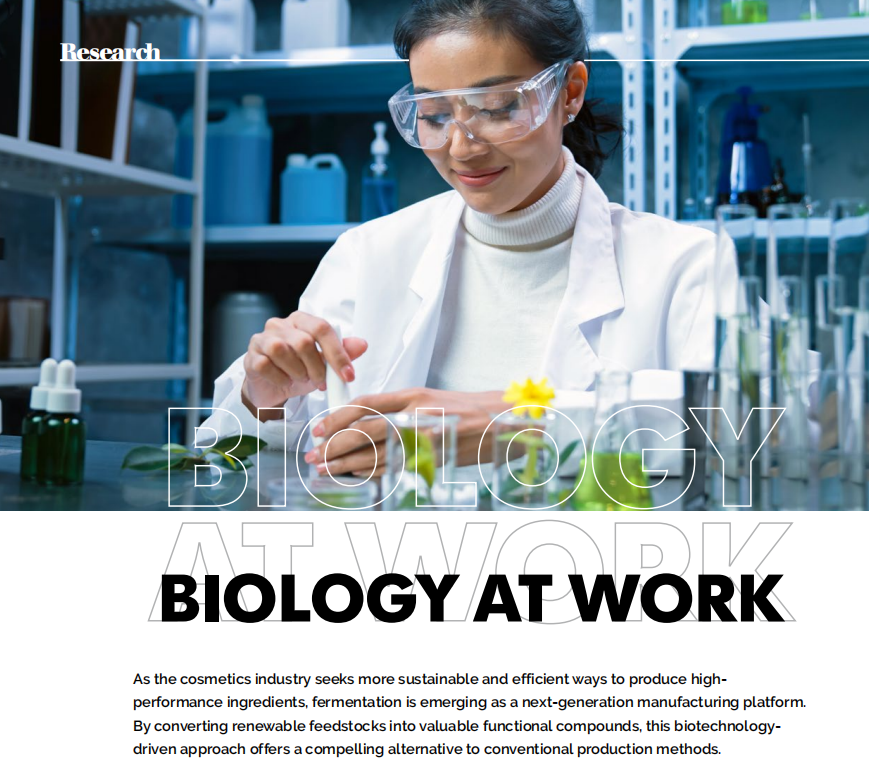
The article points out that traditional methods of sourcing cosmetic ingredients no longer meet modern demands. Plant extraction and animal-derived sources are constrained by resource consumption, climate risks, and supply chain volatility, while chemical synthesis relies on high-energy-consumption and high-polluting processes.
Fermentation, on the other hand, directly "manufactures" molecules under strict controls, achieving batch-to-batch stability and reliable supply while naturally aligning with the principles of green chemistry.
Viablife is a true "hardcore player" in synthetic biology. Established in 2015, the company has spent 11 years deeply cultivating the field of biosynthesis. Relying on its proprietary BioLego® platform, Viablife has built a complete R&D chain from genetic modification to precision fermentation. By leveraging AI-driven high-throughput screening to significantly compress the R&D cycle, and holding multiple core patents and international certifications, the company achieves stable, large-scale commercialization of synthetic biological ingredients.
Ceramides: case study in fermentation
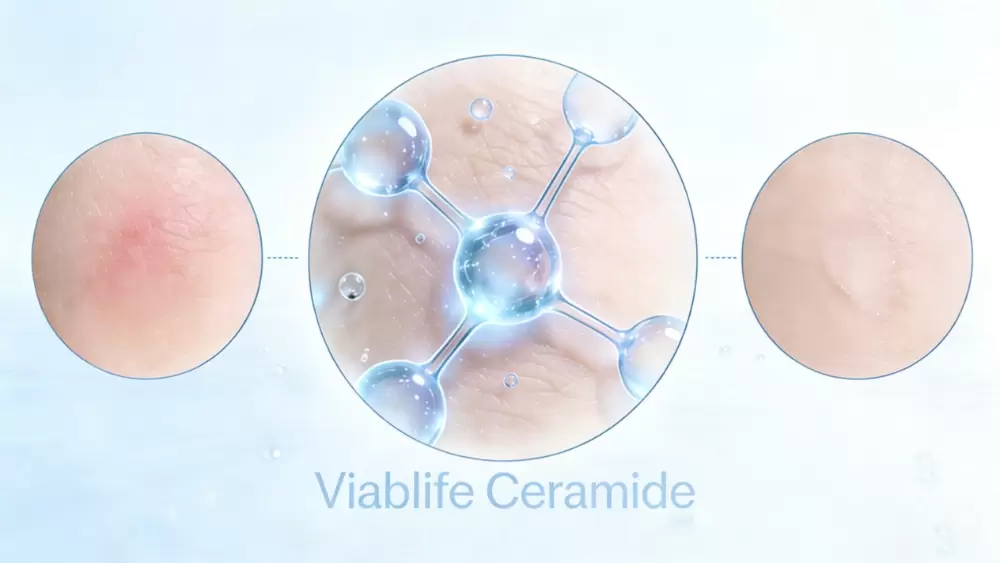
In the skincare sector, ceramides are highly representative. Ceramides are naturally occurring lipids that play a critical role in maintaining skin barrier integrity and moisture retention. They account for about 50% of the stratum corneum lipids; once depleted, barrier damage, dryness, and sensitivity will follow.
The article points out that with the growing demand for skincare ceramides, traditional ceramide production faces technical challenges. It requires multi-step purification, which increases resource consumption and manufacturing difficulty—a problem that becomes particularly prominent when preparing high-purity ceramides used in high-end skincare products.
Compared with traditional manufacturing methods, the production of ceramides via fermentation offers multiple advantages:
Ensuring Exceptional Quality:
The fermentation process takes place within controlled bioreactors, with microbial strains and culture conditions highly standardized. This minimizes batch-to-batch variability, resulting in superior stability in molecular composition and stereochemical structure. This ensures a consistent output of high-purity ceramides, meeting the stringent quality requirements for premium skincare products.
Renewable Raw Materials and Stable Supply Chain:
Fermentation utilizes renewable carbon sources, such as glucose, eliminating reliance on plant cultivation. Consequently, production is unaffected by seasonal fluctuations, climate change, or agricultural harvests, enabling stable, year-round manufacturing.
Simplified Process and Environmental Friendliness:
The fermentation method employs engineered microorganisms to produce precursor substances (such as phytosphingosine) in a single step under mild conditions, significantly simplifying subsequent conversion and purification stages. Furthermore, the process features lower energy consumption and reduced by-products, aligning with the principles of green chemistry and minimizing environmental impact.
Viablife leverages its proprietary bio-fermentation technology for ceramide production. Viablife ceramides achieve a purity of 95–98% with excellent batch-to-batch stability. The company is capable of stable, large-scale production of the four main types of ceramides—NP, AP, NG, and EOP—meeting the high-quality standards required for premium skincare products.
Viablife meticulously crafts a product matrix of three compound ceramides to fully adapt to diverse skincare formulation needs. These include the triple-ceramide compound product Viablife CeraMix Plus, Viablife Ceramide 50 with a stable Ceramide NP content ranging from 45% to 55%, and the five-ceramide compound product Viablife CeraMix V.
Backed by exceptional product quality, Viablife ceramides have gained widespread recognition and favor in both domestic and international markets, and are currently successfully applied in products from numerous renowned skincare brands at home and abroad, such as SKINCEUTICALS, SKINTIFIC, and DEXTER.
Beyond Ceramides: A Comprehensive Bio-Based Ingredient Portfolio
The conclusion of "Biology at Work" specifically highlights a fundamental shift in the industry. The application of fermentation technology now spans vitamins, amino acids, peptides, ceramides, antioxidants, and functional lipids. The industry is evolving from asking "what can be extracted from nature?" To "what can be manufactured through biology?"
This perspective perfectly aligns with Viablife’s mission: "To Create a Better Future through Innovations." Over the past 11 years, Viablife has continuously advanced and refined its synthetic biology technologies, successfully developing and launching a range of innovative, green ingredients. Beyond Ceramides, our portfolio also includes New Generation Niacinamide (with nicotinic acid<10 ppm), 100% bio-based BioNia™, Squalane, and Hydroxytyrosol. These ingredients combine exceptional quality, cost competitiveness, and low-carbon, environmentally friendly advantages, providing more sustainable and high-performance solutions for our customers.
Looking ahead, Viablife will continue to collaborate with outstanding partners around the world, empowering the power of AI-driven intelligent bio-manufacturing to accelerate innovation in the global beauty and health industries and build a low-carbon, sustainable future together.

 Leave a Message