
 Global
 Chinese
 United States
 Spain
Spain Russian
 France
 Germany
 Italian
 Japan
Japan Arabic
 Portuguese
 Korean
 Thai
Thai Greek
Greek India
India

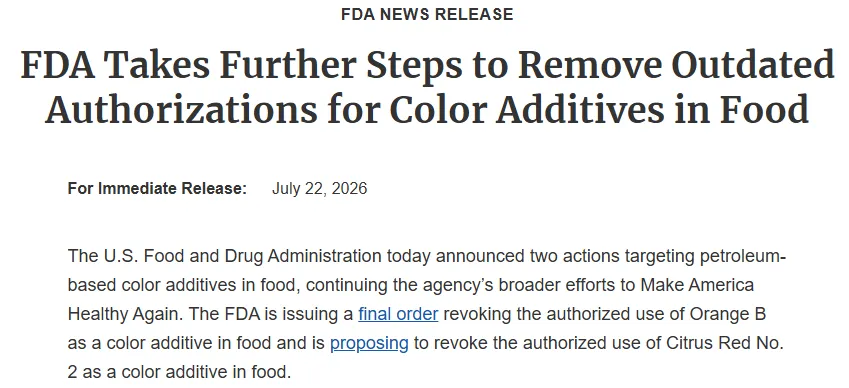
On July 23, 2026, the FDA officially issued two actions regarding the authorization of synthetic food colorants (commonly referred to in the industry as petroleum-based colorants):
•Officially revoked the color additive authorization for Orange B (Final Rule, Docket FDA-2025-C-3543)
•Proposed the revocation of the color additive authorization for Citrus Red No. 2 (Proposed Rule, Docket FDA-2026-N-6304)
Orange B — Revocation is Final
Based on the fact that Orange B has not received batch certification since 1978 and has been effectively abandoned by the industry, the FDA proposed on September 17, 2025, to revoke its authorization for use in coloring the surfaces of frankfurter and other sausage casings. Following a 30-day public comment period, the FDA received no new information that would alter its conclusion. The final rule (Docket FDA-2025-C-3543) will take effect on September 8, 2026, meaning Orange B will completely exit the U.S. food supply chain.
Citrus Red No. 2 — A 67-Year History of Proposed Revocation
Citrus Red No. 2 was provisionally listed in April 1959 and formally authorized in May 1963 for coloring the skins of mature oranges, making it a typical legacy authorization. Noting that it has received no batch certification since 2020 and has been effectively abandoned by the industry, the FDA has proposed revoking its listing regulation (21 CFR §74.302). The deadline for submitting public comments is August 24, 2026. The proposal is currently in the comment period; the FDA intends to make the final rule effective 90 days after its publication and proposes a 1-year compliance period (the exact duration is still under comment) to allow companies with certified batch inventories in the supply chain time to clear out their stock.
Acceleration of Synthetic Colorant Evaluations and Growing Focus on Natural Alternatives
The revocations of Orange B and the proposed revocation of Citrus Red No. 2 are not sudden; they are linked to the "Make America Healthy Again" (MAHA) initiative launched jointly by the HHS and the FDA in April 2025. The core objective of the MAHA initiative is to "phase out petroleum-based food colorants in the U.S. food supply, which are derived from petrochemical feedstocks." Viablife's independently developed bio-based colorant via microbial fermentation—Indigoidine®, aligns perfectly with the future direction of colorant development.
Key Advantages of Indigoidine®
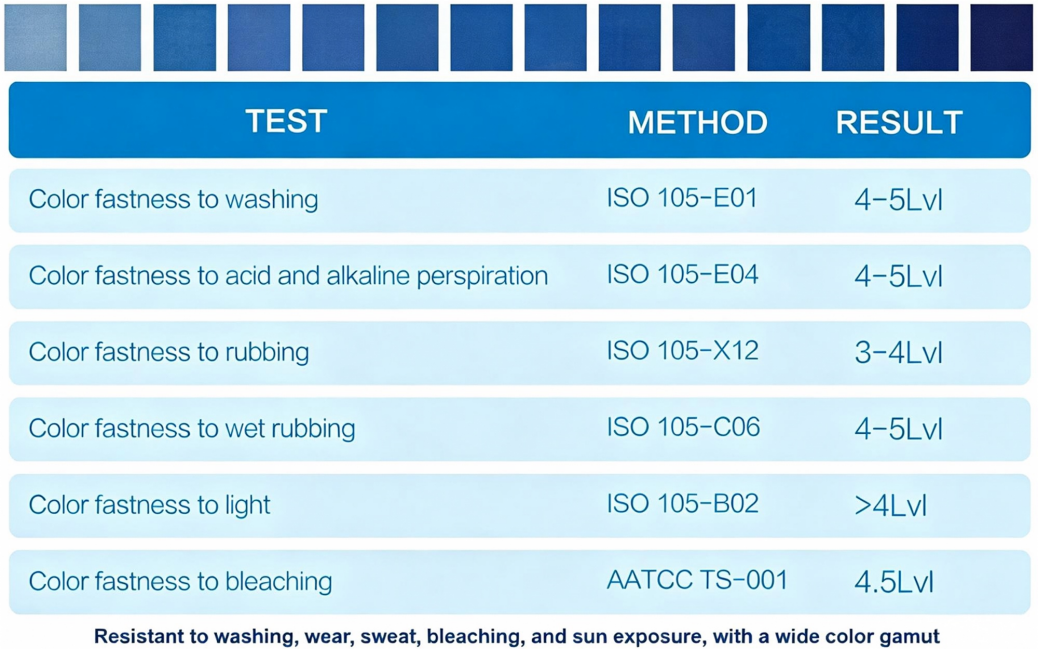
Natural Antimicrobial Properties & Excellent Color Fastness
Indigoidine® effectively inhibits common pathogens such as Escherichia coli and Staphylococcus aureus, with an inhibition rate of over 93%. It enhances end-product value, reduces the use of preservatives in relevant industries, and helps enterprises confidently navigate increasingly stringent global raw material regulations. Furthermore, it exhibits exceptional color fastness, rivaling traditional synthetic dyes and significantly outperforming plant-based dyes.
100% Bio-based: Natural · Safe · Green
Relying on unique biosynthetic technology and using natural grains as raw materials to replicate traditional brewing processes, Indigoidine® has obtained USDA 100% Bio-based Product certification and can be safely applied across multiple industries such as food, dyes, and coatings. Its detection values for fluorescent whitening agents, allergens, formaldehyde, heavy metals, and aromatic amine residues are all zero, and its 45-day biodegradation rate reaches 34.6%, making it green and eco-friendly.
Patent-Backed & Scalable Mass Production
The core technologies of the production process possess independent intellectual property rights and have been granted patent licenses in both China and the United States. It boasts industrial-scale mass production capabilities, enabling commercial promotion and application in the colorant market, with product performance meeting the demands of various colorant application fields.
Beyond Colorants: Viablife Builds a Green Ingredient Matrix
Beyond focusing on the bio-based colorants track, Viablife relies on its proprietary Viablife Biolego® platform to build a diverse matrix of biosynthetic raw materials, covering fields such as cosmetic ingredients, nutraceuticals & food additives, pharmaceutical intermediates, and biomaterials. Multiple innovative raw materials adopt green biomanufacturing processes with low energy consumption and low emissions, balancing product quality with comprehensive environmental friendliness.
In response to the global wave of green transformation, Viablife deeply cultivates upstream biomanufacturing innovation, leveraging synthetic biology technology to assist industry carbon reduction and upgrading, and joining hands with global partners to create a safe and sustainable future together.

 Leave a Message