
 Global
 Chinese
 United States
 Spain
Spain Russian
 France
 Germany
 Italian
 Japan
Japan Arabic
 Portuguese
 Korean
 Thai
Thai Greek
Greek India
India

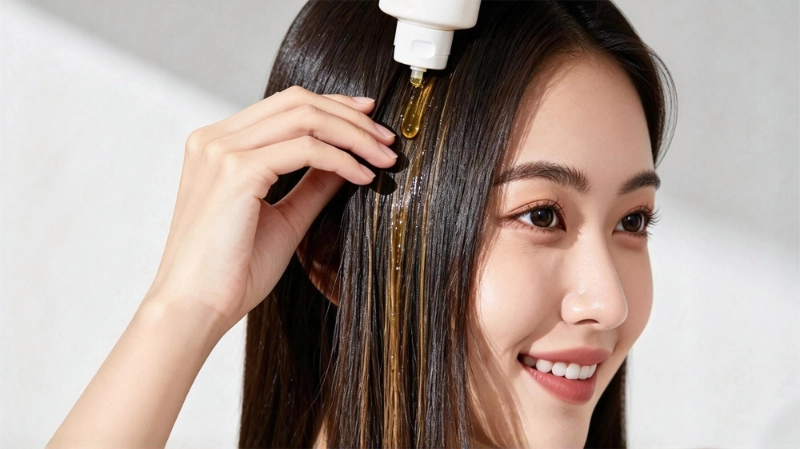
A cosmetic ingredient can create value across product categories when it combines effective performance with a pleasant sensory experience. Squalane is one option for formulators developing both hair care and skin care products. Its lightweight texture helps products spread smoothly, while its conditioning properties can help reduce the appearance of frizz and improve hair shine. In skin care, it can soften the skin, support the skin barrier, and contribute to a supple feel.
For manufacturers, this means one ingredient can open up multiple formulation possibilities—from hair oils and leave-in treatments to facial moisturizers, lotions, and selected makeup products. Viablife supplies fermentation-derived squalane with an active purity of at least 98%, giving R&D teams a raw material to evaluate across these applications.
Squalane: New Possibilities for Hair Care
Dryness, coloring, bleaching, brushing, and heat styling can leave hair feeling rough and looking dull. These changes can increase friction between strands, contributing to tangling, flyaways, and frizz. Formulators may respond by increasing the oil phase, but a heavier blend can leave some hair types feeling coated or weighed down.
Squalane offers another ingredient option. Its fluid, lightweight texture can help lubricate the hair surface, improve slip, and support a smoother-looking finish. Used thoughtfully in a hair oil or leave-in treatment, it may help formulators reduce reliance on heavier oils while maintaining—or improving—the product’s conditioning feel, shine, and manageability. The result depends on the complete formula, the hair type, and the amount applied.
In practice, squalane can complement conditioning agents that support detangling and static control. For fine hair, developers can start with a lower use level and assess residue and volume. For coarse, curly, or chemically processed hair, a different balance may be appropriate. Testing should compare shine, softness, combability, spreadability, and after-feel rather than relying on oil content alone.
Using Squalane in Hair Care Formulations
Formulators can evaluate squalane in oil-based hair products and emulsified formats, including serums, leave-in conditioners, and rinse-off conditioners. The best use level depends on the product format and the intended sensory profile.
Squalane primarily supports lubrication and surface feel; it does not replace humectants or conditioning agents with other functions. A balanced leave-in formula, for example, may combine squalane for smoothness with conditioning ingredients for easier combing and moisture-management ingredients for the desired hair feel. Assess wet and dry combing, residue, dry-down time, and performance across relevant humidity conditions.
Development goal | The benefits squalane can provide |
Improve dull-looking hair | Supports a smoother, more polished finish |
Reduce tangling | Provides lubrication and slip |
Avoid a heavy finish | Offers a lightweight option for balancing the oil phase |
Improve dry-end feel | Helps improve surface feel |
These are formulation directions to investigate, not guaranteed outcomes. Instrumental tests and sensory evaluations should confirm the performance of the finished product.
Squalane Also Fits Skin Care
Squalane has a soft texture and is easily absorbed, making it equally suitable for the cosmetics industry. It can impart an excellent skin feel to products and enhance consumer appeal. Meanwhile, squalane has a lipid structure highly similar to human sebum, allowing it to form a highly permeable sebum protective film on the skin's epidermis. This effectively prevents moisture loss, strengthens the skin barrier, and helps the skin maintain a long-lasting, hydrated, and healthy state.
With the aforementioned excellent properties, squalane demonstrates enormous application potential in the skincare field. Featuring mild properties and exceptional safety, it is also applicable to infant care categories, allowing it to be formulated into newborn massage oils, diaper rash repair creams, and other products to gently care for delicate and fragile infant skin. Furthermore, it can be expanded into sectors such as post-aesthetic procedure repair, anhydrous formulation systems, men's grooming, and eco-friendly cosmetics, catering to diverse cosmetic development needs.
More Formulation Possibilities Across Skin Care, Hair Care, and Makeup
Squalane can give R&D teams more flexibility when exploring concepts across multiple cosmetic categories. Beyond hair care and skin care, it can be evaluated in selected makeup products, including foundations and lip products, where spreading, comfort, and finish are important. Each format has different requirements: a foundation must work with pigments and film formers, while a lip product may prioritize gloss, adhesion, and wear.
Using the same ingredient across categories does not mean using the same formula or concentration. Compatibility, stability, sensory performance, and the intended product claims should be evaluated separately. Nevertheless, squalane can provide a useful starting point for manufacturers seeking to develop related product concepts with a shared raw material.
Why Consider Viablife Sugualane?
Viablife produces squalane through yeast fermentation using its proprietary Biolego synthetic biology platform. This offers a non-animal production route for cosmetic ingredient development and may be relevant to brands exploring vegan product concepts or seeking to avoid shark-derived materials. Any vegan, cruelty-free, or sustainability claims should be supported by appropriate documentation; environmental performance should be assessed using relevant manufacturing and supply-chain data.
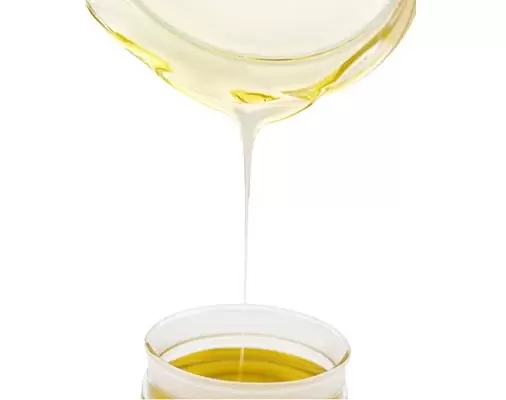
Viablife’s listed specifications include an active purity of 98% or higher, a clear and colorless oily appearance, the INCI name SQUALANE, and CAS number 111-01-3.
Product Name | |
INCI | SQUALANE |
CAS No. | 111-01-3 |
Purity | ≥98% |
Appearance | Colorless clear oily liquid |
Viablife reports a 60,000 m² manufacturing facility and fermentation capacity of 10,000 tons. For commercial evaluation, manufacturers should confirm batch consistency, production lead times, packaging options, documentation, and the supplier’s ability to support ongoing orders. Aligning these details early can help connect laboratory trials with scale-up and purchasing plans.
Frequently Asked Questions
Is squalane suitable for fine hair?
It can be considered for fine hair when used at an appropriate concentration. Developers should evaluate spreading, residue, volume perception, and the amount needed per application to avoid an overly rich finish.
Can squalane repair damaged hair?
Squalane can improve lubrication, softness, and surface smoothness, but it does not permanently reconstruct damaged hair fibers. It is best used as part of a broader conditioning formulation.
What is the difference between squalane and a humectant?
Squalane is primarily an emollient that improves softness and surface feel. Humectants attract and retain water. Combining these ingredient types can help address different aspects of a hair or skin care formulation.
Can fermentation-derived squalane be used in skincare and makeup?
Yes. It can be evaluated for facial moisturizers, facial oils, and selected color cosmetics. Compatibility and stability should be assessed according to the finished product's composition and intended use.
 Leave a Message