
 Global
 Chinese
 United States
 Spain
Spain Russian
 France
 Germany
 Italian
 Japan
Japan Arabic
 Portuguese
 Korean
 Thai
Thai Greek
Greek India
India

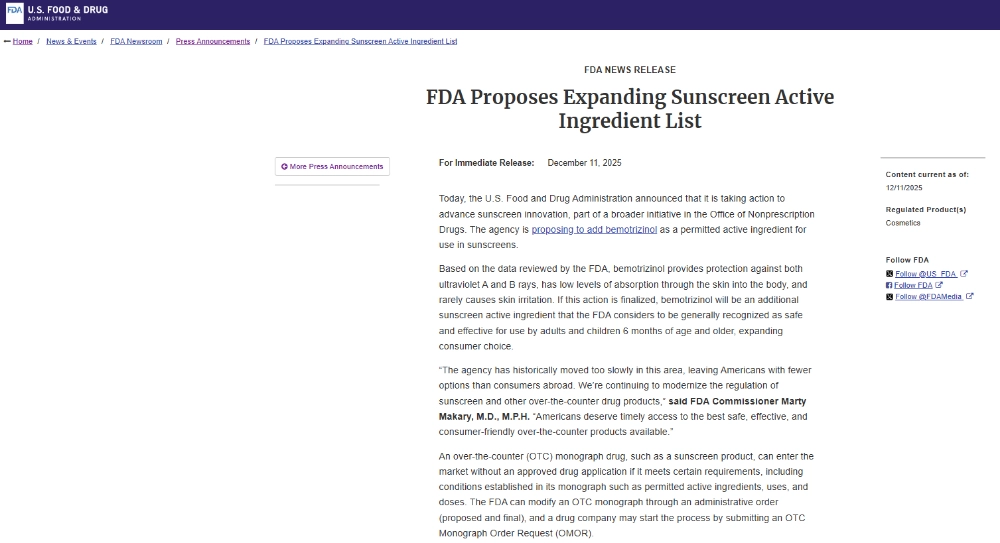
In December 2025, the U.S. Food and Drug Administration (FDA) issued an announcement proposing to add Bemotrizinol (hereinafter referred to as BTZ) to its list of approved sunscreen actives, opening a public comment period. If the substance is ultimately deemed safe and effective, the FDA will issue an official document to include BTZ in the list of approved sunscreen ingredients under Over-the-Counter (OTC) Monograph M020.
This move is regarded as one of the most significant updates to the U.S. sunscreen regulatory framework in recent years. Since 1999, the U.S. sunscreen market has relied on only 16 traditional active ingredients. In contrast, BTZ has been used safely in the European Union for 25 years and approved in over 100 countries worldwide. This proposal signals that the FDA has broken the regulatory impasse and accelerated alignment with international standards. As a bis-triazine sunscreen widely used in multiple global markets, BTZ offers broad-spectrum UVA/UVB protection, extremely low skin penetration rate, and a proven safety record. The formal evaluation and approval progress of BTZ by the FDA sends a clear message: the U.S. market is opening up opportunities for new generation sunscreen formulations.
The Evolving Role of Sunscreen: From “Protection” to “Skin Management”
As high-performance sunscreen actives gradually become mainstream, the industry’s perception of sunscreen products is undergoing a transformation. Sunscreen is no longer merely a technical solution for blocking ultraviolet (UV) rays; it is now recognized as a critical step in daily skincare routines that exerts a profound impact on long-term skin health. Practical evidence shows that even modern sunscreen systems with high safety profiles may impose cumulative stress on the stratum corneum lipid structure and skin barrier with long-term or frequent use, manifesting as dryness, tightness, sensitivity, or reduced skin tolerance. Therefore, relying solely on the protective efficacy of sunscreen actives can no longer meet the demands of consumers and professional formulators for "long-term skin health".
Opportunities Brought by BTZ: Creating Formulation Space for "Sunscreen + Repair" Synergy
As an oil-soluble broad-spectrum UV absorber, BTZ captures UVA and UVB energy through its molecular conjugated structure and converts it into harmless thermal energy for release. Meanwhile, its high stability protects both itself and other ingredients in the formulation, achieving long-lasting sun protection. The key value of BTZ lies not only in its sun protection efficiency but also in its low-permeability property, which provides greater room for functional design in formulations. Unlike early sunscreen actives that were limited by skin irritation and heavy texture, BTZ-based sunscreen systems are more compatible with barrier-repair and photoaging-care ingredients. This redefines sunscreen products from a "necessary burden" to a daily skincare staple that balances protection and comfort, also enabling structural upgrades for premium sunscreen offerings.
The Logic Behind a “Sunscreen + Repair” Synergistic System
When BTZ is combined with ceramides and nicotinamide in sunscreen products, the three ingredients form a clear and complementary functional system: sunscreen actives directly block UV rays, ceramides maintain the structural stability of the skin barrier, and nicotinamide regulates UV-induced biological responses. This synergistic design elevates sunscreen products from single-function items to comprehensive solutions that deliver both immediate protection and long-term skin condition management, which is precisely the core driving force behind the rapid growth of the premium sunscreen market.
The Irreplaceable Role of Ceramides in Sunscreen Systems
In sunscreen formulations centered on BTZ, ceramides play an irreplaceable foundational structural role. As a core component of the stratum corneum lipid system, the incorporation of ceramides in sunscreen products essentially provides structural reinforcement against the barrier stress potentially caused by UV radiation and sunscreen actives. By replenishing and stabilizing the stratum corneum lipid structure, ceramides can significantly alleviate dryness and improve skin tolerance associated with long-term sunscreen use, making high-protection products more suitable for dry, sensitive skin types and individuals requiring year-round sun protection. Viablife ceramides, characterized by high purity and stability, deliver sustained barrier repair and structural stabilization effects in sunscreen systems, laying a solid foundation for the long-term safety of formulations.
Nicotinamide: The Key Bridge Connecting Sunscreen and Anti-Photoaging
If BTZ addresses how UV radiation is blocked, nicotinamide focuses on how the skin recovers and regulates itself after UV exposure. The role of nicotinamide in sunscreen has long extended beyond whitening or oil-control claims.
By inhibiting UV-induced melanin transfer, mitigating inflammatory responses, and improving sebum balance, nicotinamide helps the skin manage the long-term consequences of photodamage. Viablife’s new generation nicotinamide, with strict impurity control (nicotinic acid<10 ppm) and optimized irritation risk management, is particularly well suited for high-frequency sunscreen applications. It enhances skin comfort and tolerance while enabling brands to establish a more complete and credible photoaging prevention strategy.
The Rise of Functional Sunscreen as a Global Market Standard
As global consumer demand for functional sunscreens accelerates, international brands are actively positioning themselves around the combination of Bemotrizinol, ceramides, and nicotinamide. This trio has become a defining label of premium sunscreen competitiveness. Representative examples include:
1. Bioderma Photoderm MAX SPF50+ PA++++
• Core sunscreen system: Bemotrizinol (2.0%) + Uvinul A Plus + Zinc Oxide, delivering stable full-spectrum protection.
• Skincare ingredients: Ceramide NP (strengthens barrier, reduces transepidermal water loss), Niacinamide (2.0%, inhibits melanin transfer, brightens skin tone), Vitamin E (synergistic antioxidant).
2. La Roche-Posay Anthelios XL SPF50+ PA++++
• Core sunscreen system: Bemotrizinol (1.5%) + Mexoryl SX + Mexoryl XL, providing UVA protection with a persistent pigment darkening (PPD) value of 46.
• Skincare ingredients: Ceramide NP (repairs damaged barrier), Niacinamide (1.8%, improves pigmentation, enhances skin resistance), Hyaluronic Acid (deep moisturization).
FDA’s Push for BTZ Approval: Unveiling Key Industry Trends
The U.S. has the highest incidence of skin cancer in the world. The approval of BTZ will enhance the actual protective efficacy of sunscreen products, help reduce the burden of UV-related diseases, and align with the FDA’s public health goal of "reducing skin cancer risk". The FDA’s push for BTZ approval is not an isolated ingredient adjustment but reflects a regulatory re-examination of the overall quality and consumer experience of sunscreen products. In the future, sunscreen products will be evaluated based on both "protective efficacy" and "skin-friendliness". The synergistic design of sunscreen actives with barrier-repair and anti-photoaging ingredients will gradually evolve from a differentiating selling point to a fundamental industry standard. For brands, this represents not just a formulation upgrade but a restructuring of product positioning and long-term strategy.
Viablife’s Position in the New-Generation Sunscreen Ecosystem
In sunscreen systems represented by BTZ, Viablife’s ceramides and nicotinamide are not merely optional additives but key components that enable the transformation of sunscreen products from "protection-only" to "protection + repair". With high purity, stability, and excellent formulation compatibility, Viablife provides brands with a reliable raw material foundation for developing long-tolerable, frequently usable sunscreen products. This helps sunscreen products truly integrate into daily skincare routines rather than becoming a burden to the skin. The core of modern sun protection is no longer simply blocking UV rays from the sun, but maintaining the skin in a stable, healthy, and comfortable state even under UV exposure.

 Leave a Message